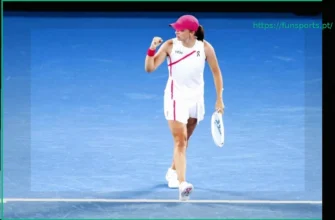

Once upon a time, not so long ago, the idea of Iga Swiatek not dominating Roland Garros was unthinkable. Her reign on the Parisian clay, from 2020 to 2024, saw her win the tournament four times and achieve an astonishing 26-match winning streak. The French Open became her personal kingdom, so unassailable that discussions shifted from her tennis prowess to her place in history.
However, the years 2025 and 2026 brought unexpected challenges. Now, as a new clay court season dawns, Swiatek faces it with a new coach, a dented confidence, and a ranking that no longer guarantees her automatic status among the elite. The question of her dominance is no longer rhetorical; it has become one of the most captivating narratives in the sport.
Can Iga Swiatek Ascend to the Top of the Clay Court Again?
The Cracks in the Clay Kingdom
The decline wasn’t abrupt but rather a gradual erosion, each stage seemingly explainable until the cumulative effect became impossible to ignore. In 2025, Swiatek was unable to defend her titles in Madrid and Rome, losing 2,000 ranking points and dropping out of the top four for the first time since early 2022. On a surface where she had previously been nearly unbeatable in a single season, she failed to reach a single clay court final. Her loss to Danielle Collins in Rome, a player she had previously dominated, further highlighted her struggle to find her game.
Paris offered a temporary respite. She reached the semi-finals, overcoming a tough match against Rybakina, and showed flashes of her old form. However, Sabalenka ended her 26-match Roland Garros winning streak in the semi-finals with a resounding 6-0 victory in the final set, a clear statement of intent. Sabalenka and Rybakina became the only players to have defeated Swiatek on clay twice, a notion that would have seemed absurd just a few years prior. While the dynasty wasn’t over, its unquestionable dominance had ended, and the era of Swiatek as an automatic French Open champion had concluded.
The latter half of 2025 brought a surprising turn. Wimbledon, a surface where Swiatek had historically shown less conviction, saw her lift the trophy. A surprising final appearance in Bad Homburg boosted her confidence, leading to her Wimbledon victory, her sixth Grand Slam title, sealed with a decisive win over Anisimova in the final. This was a remarkable achievement, proving her capability to win major events. Yet, it also underscored the peculiar nature of her current trajectory: the player who built her legend on clay triumphed on grass, only to falter again on hard courts at the start of 2026.
The Coaching Carousel and Its Significance
Swiatek’s decision to part ways with Wim Fissette in March 2026 marked the third significant coaching change in her career within four years, each signifying a distinct phase. She had previously split with the coach who guided her to her first Roland Garros title at the end of 2021, followed by a separation from Tomasz Wiktorowski in late 2024, and now Fissette after a challenging sixteen months. The Fissette departure was announced shortly after her streak of 73 consecutive opening-round wins was broken at the Miami Open, where she lost to compatriot Magda Linette.
The appointment of Francisco Roig is particularly noteworthy, especially given his extensive work with Rafael Nadal. Roig is renowned as a demanding coach with a deep understanding of technique. His coaching philosophy is intrinsically linked to clay court play, focusing on high-spin baseliners who rely on strategy and endurance. The fact that his most prominent collaboration produced the greatest clay court player in history is hardly coincidental.
Roig’s coaching approach suggests that Swiatek could become an even more complete player if she can enhance her serving accuracy and diversify her game. He previously encouraged variety and net play with Raducanu, though the player ultimately did not fully embrace the tactical shift. Swiatek, a six-time Grand Slam champion with a proven ability to integrate coaching changes into significant improvements, presents a very different prospect. Her reported training sessions at the Rafa Nadal Academy in Manacor as she begins her trial with Roig underscore the seriousness of her commitment and the direction she is aiming for.
The Case for a Resurgence
When a dominant champion begins to falter, the temptation is to project a continuous decline. This is almost always a miscalculation, and it would be particularly erroneous with Swiatek. Her fundamental strengths remain intact. She is still one of the most physically resilient players on the tour, possessing truly elite movement on clay. Her forehand, a formidable weapon, continues to generate one of the heaviest balls in women’s tennis. Her ability to absorb and redirect pace, a cornerstone of clay court play, has not diminished.
What has been affected is the mental certainty that made her so formidable. The doping suspension in late 2024, public scrutiny, coaching changes, relinquishing the world number one ranking, and her first Roland Garros defeat in years have collectively created a psychological burden that has periodically impacted her game in ways that statistics alone cannot fully convey. Despite a completely new coaching setup, she still secured 62 Tour match wins in 2025, becoming the first player since the turn of the millennium to achieve four consecutive 60-win seasons, a feat previously accomplished by Martina Hingis and Lindsay Davenport. Such an achievement is not indicative of terminal decline but rather a player in transition.
The appointment of Roig appears to be more than a mere tactical adjustment; it signifies a genuine effort to rediscover not just a playing style but a mindset. History suggests that she finds another level in the spring. Whether this year will break the pattern of her recent struggles remains one of the most intriguing questions surrounding the clay season. Clay is the surface where her muscle memory is most deeply ingrained, her footwork most automatic, and her tactical repertoire most extensive. If she is to rebuild her confidence anywhere, it will be on the red dirt.
The Obstacle
This analysis should not be interpreted as a prediction of a straightforward title defense, as Swiatek is no longer defending anything; she is chasing. The landscape of women’s tennis has shifted while she has navigated her challenges, with Sabalenka’s rise being the most significant development. Sabalenka has dominated in 2026 with a 23-1 record, achieving the Sunshine Double by winning both Indian Wells and Miami, joining an elite group that includes Steffi Graf, Kim Clijsters, Victoria Azarenka, and Swiatek herself. Sabalenka reached the Roland Garros final in 2025 and has a Madrid title to her name. Her clay court game has been steadily improving, and the mental barrier she once faced against Swiatek on this surface has been overcome. Her victory over Swiatek in Paris, with a score of 7-6, 4-6, 6-0, demonstrates this shift. Sabalenka is no longer an opponent Swiatek can manage; she is an opponent Swiatek must solve.
Coco Gauff presents another formidable challenge. At the 2025 French Open, Gauff became the youngest woman to reach the finals of Madrid, Rome, and Roland Garros in the same year, before ultimately defeating Sabalenka in the Paris final. She is the reigning champion, her confidence is growing with each clay court swing, and her movement on the surface is arguably the best in women’s tennis. The path to victory in Paris has never been more challenging for Swiatek since her first triumph there.
A Story Yet to Reach Its Conclusion
The honest answer, mirroring much of Swiatek’s recent career, is that the outcome remains uncertain. What is clear is that the elements for a resurgence are present: a logical coaching change, training at an academy designed for clay court excellence, a player who has proven her resilience across six Grand Slam titles, and a surface that, despite recent results, remains where her game is structurally most at home. However, it is also evident that the competition is fiercer than ever, the psychological burden is heavier, and the gap between her current form and her peak clay court performance is a tangible reality that a new coach cannot simply erase.
If this clay court season reveals a revitalized Swiatek – more versatile, more composed, and more self-assured – then Roland Garros remains well within her reach. Conversely, if it mirrors the early clay season of 2025, marked by hesitation, unforced errors, and losses to opponents she once easily dispatched, then we are witnessing a genuinely new chapter in her career. Regardless of the outcome, this narrative promises to be the most compelling storyline in the women’s draw, and its resolution, as has been the case with much of her career, will undoubtedly unfold on the red clay.